The first year-long intern cohort ended with many successes, and 90 more interns started this Fall!
The 2025–26 academic year was the first time we asked DefaultVeg interns to stay for two semesters instead of one—in the middle of degrees, jobs, and everything else college demands. Sixty-five students said yes and showed us what this generation is capable of accomplishing for a better food system, on their campuses and beyond.
Shifting dining toward plant-rich food is a climate solution students can work on directly, on their own campuses, with the people who already run the kitchens. Here are their results:
The 2025-26 academic year in numbers
- 39 changes implemented to campus food, from removing plant milk surcharges to plant-based defaults at conferences and events, to Climate-Friendly Ratios in cafeterias
- 48 research projects completed on student food choices, food service design, and identifying hundreds of campus allies for future intern and advocate projects.
88% of graduates say they expect to keep working on food systems change in their education and careers
Switching to the longer program helped us achieve our goals: a student advocacy network that both drives plant-forward changes on campuses each year and fuels a strategic, data-driven movement to make plant-centered dining the norm across higher education over the next decade.
– Jennifer Channin, Executive Director, Better Food Foundation
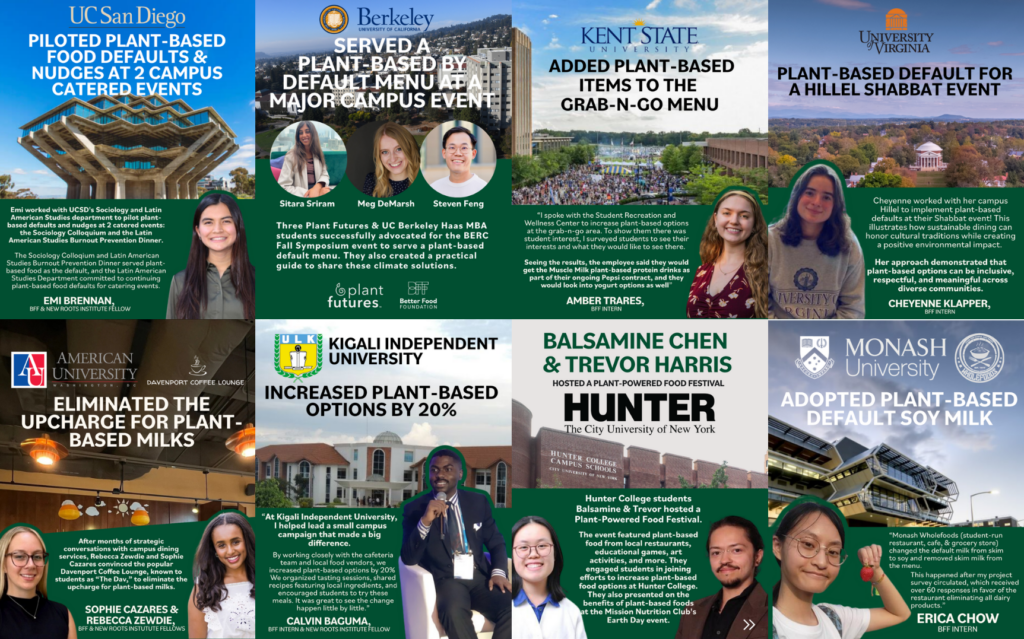
Students changed their campus food system
Howard University became the first HBCU to remove its plant milk surcharge at every campus cafe, thanks to intern Zaryah Stroman. It’s a Plant-Based Defaults change that makes cafes more accessible for students with lactose intolerance and other dietary needs.
UC San Diego piloted plant-based defaults at 2 catered events following advocacy by intern Emi Brennan, who cold-emailed department leaders about behavioral nudges. Emi made her case in an op-ed in the UCSD Guardian, arguing for dining environments that make the sustainable, ethical choice the easy one, and congratulating the university for also eliminating plant milk surcharges at all dining halls. Partnering with @newrootsinstitute, Emi is proving that smart strategy equals massive climate action.
Emory University created a $10,000 Sustainable Food Fund through student-government legislation written and passed by intern Ania Ting. Club events receive funding when they use Climate-Friendly Ratios, serving at least two plant-based dishes for every animal-based one.
Duke Kunshan University in China piloted an oat-milk default at a campus cafe, thanks to the advocacy of intern Marielle Williamson. Within three weeks, oat milk sales rose 140%, replacing more than 70 liters of dairy milk.
Alongside our own 65 interns, we partnered with PlantFutures and the New Roots Institute to support 11 shared Fellows on their plant-based default projects.
The work keeps growing after graduation
Changing a menu is one thing. Leaving behind the research and relationships to keep driving campus food change forward is another. That’s what the extra semester offered.
This was the first class to test the new Student Food Choice Survey we developed with the Center for Food Systems Transformation at the University of San Diego. The survey collects year-on-year data on the factors that shape students’ food choices in dining settings, giving future advocates (students and dining professionals alike) a stronger case to present to campus leadership. We’re rolling it out nationally this fall with several NGO partners.
We can also put an impact number on these campus food transformations. Our new Plant-Based Nudge Calculator estimates how many meals a default or nudge change shifts and how much it cuts carbon emissions, so a student walking into a meeting with dining leadership can show what one menu change is actually worth.
Try the Plant-Based Nudge Calculator →
Interns also identified hundreds of campus allies: chefs, sustainability staff, student government members, and faculty who will still be there when the next cohort arrives.
To see a full report on student achievements in the last year, check out our Annual Report.
Students & dining professionals aligned
The internship is the heart of our higher education work, and it’s built to complement what our staff and Plant-Based NGO Network members do directly with campus food professionals: shaping menus and the procurement decisions that determine what gets served.
So far in 2026, we’ve presented on plant-rich dining and behavioral science to 197 higher education food professionals through their own associations. That includes 37 campus sustainability leaders who spent three hours with nudge pioneer Cass Sunstein in a workshop we organized with AASHE, and 160 dining professionals across two NACUFS conferences. We also trained 100+ more students and faculty in classrooms and at student events.
These training sessions close the gap between student changemakers and the campus food service professionals. Both want the same thing: delicious, healthy dining on campus. We help them see that their goals are aligned and achievable through behavioral science strategies.
90 DefaultVeg Interns start this Fall 2026
The Fall 2026 cohort is our largest yet: 90 interns covering 70 campuses in the US and Canada, with 16 graduate-level students! They’re not starting on the ground floor either—they come equipped with research already collected, allies already mapped, and dozens of case studies they can put in front of their own dining directors, completed by the interns who graduated before them, as well as a new Nudge Calculator that conveys the impact of these simple changes on meals shifted, carbon emissions cut.
🙏To our 2025–26 cohort: thank you for the groundwork you built!
Latest News
See All News39 Campus Wins for Student-Led Plant-Based Nudges & Defaults
Sixty-five students, two semesters each, 39 changes to how campus food gets served. Here’s what the first year-long DefaultVeg 2025-26 cohort accomplished. And the next 90 interns start this Fall.
5 Takeaways on Plant-Based Campus Dining from NACUFS 2026
Five takeaways from our panel and the conference floor, on why the values-behavior gap is a design problem and what students actually order when you get it right.
Storytelling as Climate Strategy: Nudge Workshop with LARC & YP2F
Shredded Shiitake Mushroom Tacos. BBQ Jackfruit Wrap. Tropicali Flan made from kelp. Here’s what happened when BFF brought behavioral science to LA journalists at LARC x YP2F.