What campus dining teams should know about Gen Z’s plant-forward demand, from our panel
In July, the Better Food Foundation team traveled to New Orleans for NACUFS Nationals 2026, the flagship annual gathering of the National Association of College and University Food Services. Campus chefs, dining directors, sustainability leads, and culinary innovators came together to work through the hardest questions in campus food, and plant-forward dining was more prominent than ever.
Our panel, “Shifting Gen Alpha and Gen Z Food Norms: Student Voices,” drew a full room of more than 40 food service professionals. Here are our takeaways from the panel and conference.
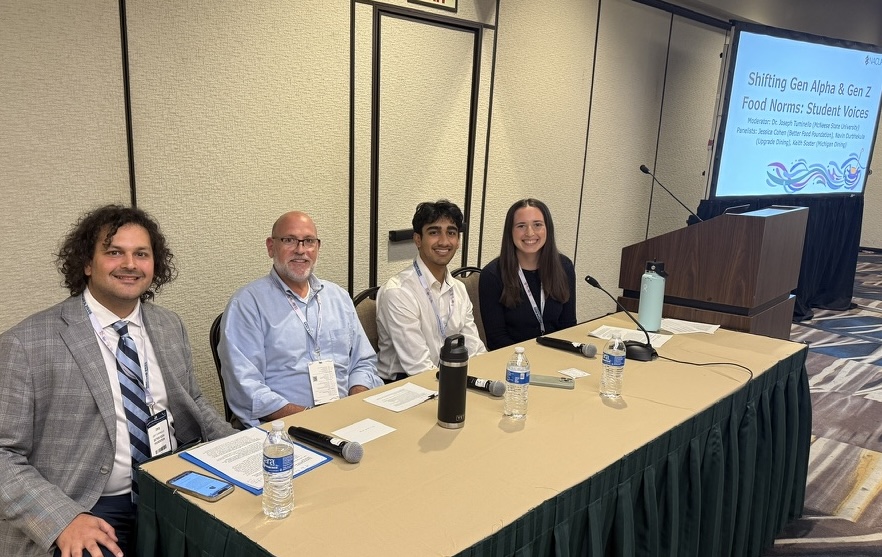
Moderator: Dr. Joey Tuminello, Associate Professor, McNeese State University
Panelists:
- Jessica Cohen, Program Coordinator, Better Food Foundation
- Navin Durbhakula, CEO, Upgrade Dining
- Keith Soster, Director of Sustainability, Student & Community Engagement, Michigan Dining
1. The “vegan student” mental model is holding dining teams back
Dining professionals have long sorted students into neat categories: vegan, vegetarian, and everyone else. That framework no longer reflects who’s actually sitting in the dining hall.
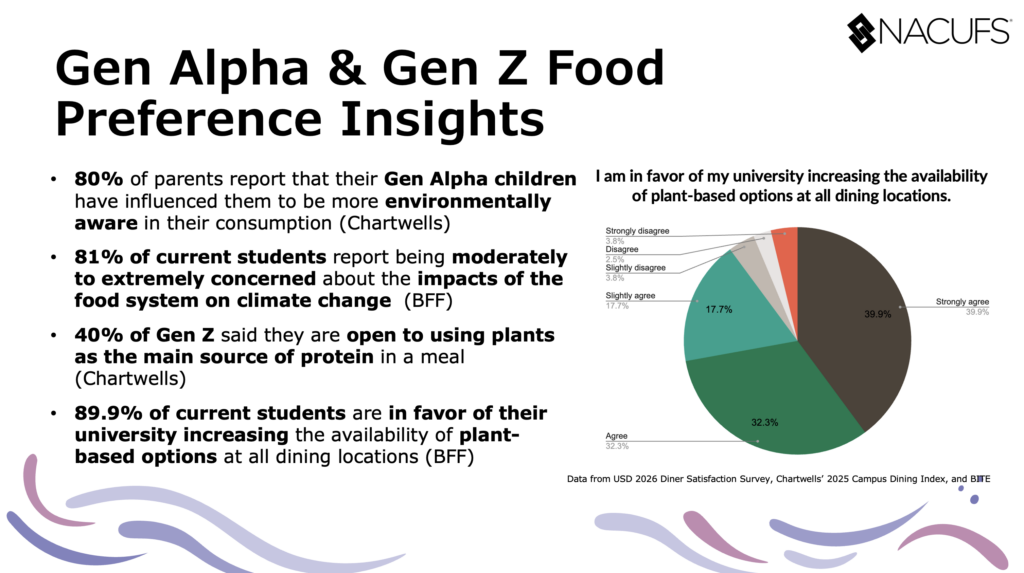
Gen Z students don’t define themselves by dietary labels. 84% of Gen Z report making sustainable food choices, and 40% are open to plants as their primary protein source, but almost none of them call themselves vegan. The shift happening isn’t toward veganism. It’s toward a flexible, protein-diverse diet where plants take center stage more often.
If dining teams design plant-forward options only for “the vegan table,” they miss the much larger group of students who want more plants on their plate and can’t find them.
2. The values-behavior gap is a design problem, not a student problem
This was the panel’s most actionable insight, and it visibly landed with the room.
Students say they care about sustainability, health, and animal welfare. Then they reach for the burger. Dining teams often read that as evidence that students don’t really mean what they say. That’s the wrong interpretation.
“It’s not that students don’t want to eat in alignment with their values. It’s that the food that is most prominent and convenient doesn’t align with them,” said Jessica Cohen, BFF’s Program Coordinator. “When dining teams design environments so that the easiest, default options reflect students’ values for sustainability, health, and social justice, that’s what they’ll eat.”
When a student walks into a dining hall and the first thing they see is a burger station, they eat a burger. Not because their values changed, but because the environment made that the path of least resistance.
Closing the values-behavior gap is a design challenge, not a student education challenge. That’s exactly what Plant-Based Defaults are built to address.
3. Integration beats segregation
Data from Upgrade Dining’s survey of more than 10,000 students across 10 universities makes one thing clear: students don’t want a vegan corner. They want plant-forward food woven throughout the menu, prepared well, and presented without the allergen-label treatment.
“Students consistently tell us that plant-based meals don’t have enough protein and aren’t well-seasoned,” said Navin Durbhakula, CEO of Upgrade Dining. “That’s not an argument against plant-based food — it’s an argument for doing it better. When we get the flavor and the protein right, the demand is absolutely there.”
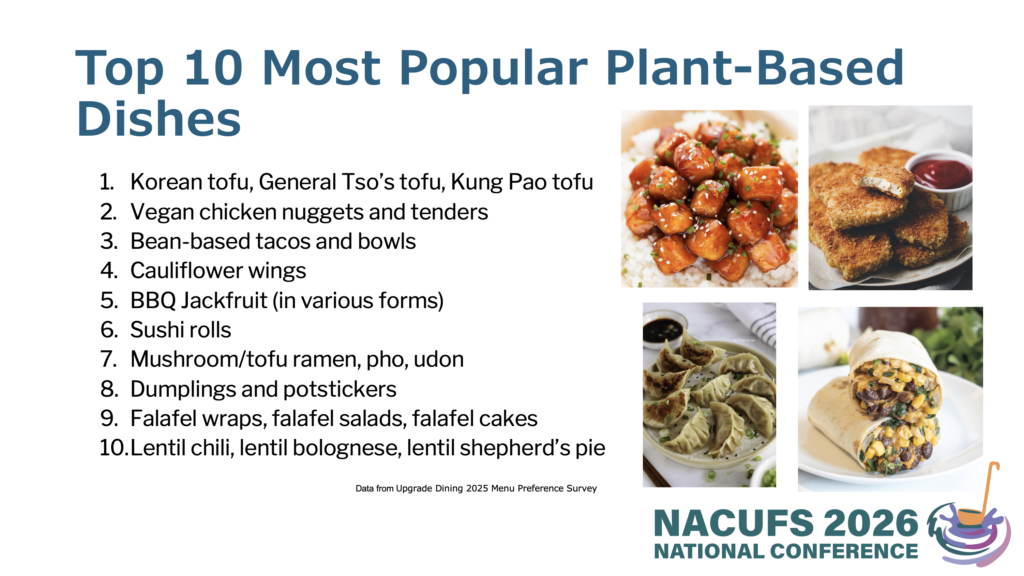
The most requested dishes — Korean tofu, bean tacos and bowls, mushroom ramen, falafel wraps, lentil bolognese — aren’t niche. They’re globally inspired, protein-forward, and deeply familiar to this generation. Dining teams that treat plant-based as a separate category make it harder for students to find what they’re already looking for.
4. Small structural changes produce outsized results
The panel shared a series of student case studies from BFF’s DefaultVeg-trained interns who advocated for and helped implement low-friction food service changes that had a significant impact.
At Cornell, we helped our campus remove the plant milk surcharge, driving adoption overnight with minimal operational friction. At the University of British Columbia, student Cloe Sousa piloted Oat Milk by Default in campus coffee programs. At Howard University, Zaryah Stroman removed the plant milk surcharge across campus. Similar changes have taken hold at UC San Diego, American University, Emory, and Otis College of Art and Design.
These weren’t sweeping overhauls. They were targeted nudges that made the plant-forward choice the easy choice, and students led the way.
The Sodexo plant-based defaults study, piloted at three universities and now expanding to more than 400 campuses across North America, confirms what BFF has documented for years. When you change the default, you change behavior. No options removed, no menus overhauled, no students lectured.
5. The plant-forward marketplace is ready for campus scale
Beyond our panel, the conference floor told its own story. Vegpreneur, which helps emerging plant-based brands break into campus dining, brought together a section of exhibitors purpose-built for food service scale. Established names and newer entrants alike were showing product lines designed for the operational realities of campus dining.
This isn’t a fringe marketplace anymore. It’s a growing infrastructure built to meet dining teams where they are.
Questions from the audience
The room asked sharp, real-world questions that reflect where dining professionals are right now.
On cultivated meat. A fair and forward-looking question. Cultivated meat remains largely pre-commercial at dining scale, with regulatory and cost barriers still in play. For now, the higher-leverage opportunity is plant proteins that are already supply-chain ready, operationally proven, and student-preferred.
On ultra-processed ingredients in plant-based products. Students and parents are raising this concern, and dining teams are hearing it. Worth noting directly: “ultra-processed” is a broad and often misapplied label. What matters is the ingredients and nutrients in a product and how it fits into an overall diet, not its level of processing alone.
Many plant-based whole foods, including beans, peas, lentils, tofu, tempeh, and oats, are among the least processed foods on any menu. Some packaged alternatives are more processed, but so are plenty of conventional meat and dairy products that rarely receive the same scrutiny. The answer isn’t to avoid plant-based food. It’s to evaluate products on their actual merits, center whole plant foods as the foundation, and treat alternatives as one part of a varied menu.
What we’re taking back to the work
A few broader observations from the conference.
Dining teams care deeply about keeping pace with student demand. Many have built student dining committees, focus groups, and polling processes to understand what students want, and they’re looking for research-backed strategies that give them confidence to act on what they’re hearing.
Food prices are creating an unexpected opening. High meat costs and supply chain volatility are pushing dining teams toward more price-stable alternatives. Plant proteins, which tend to be comparatively stable in price, now carry a cost argument alongside the climate-smart and nutrition ones. That’s a meaningful shift.
The most effective student advocates aren’t the ones sending complaints. They’re the ones who learn the operational constraints, speak the language of the kitchen, and propose low-friction changes dining teams can actually implement. The DefaultVeg Internship Program trains students to be exactly that kind of partner.
The energy at NACUFS Nationals suggests an inflection point. Plant-forward dining is no longer a niche topic at the margins of campus food service. It’s becoming central to how dining professionals think about sustainability, nutrition, and student satisfaction, and the operational tools, supplier networks, and student advocates are finally ready to meet them there.
Ready to bring Plant-Based Defaults to your campus?
Whether you’re a dining director looking to pilot a nudge, a student advocate building a case for your dining, catering, or event teams, or an NGO partner working toward food systems change, we can help.
Join a free Nudge Training | DefaultVeg Internship Program | Join the NGO Network
Latest News
See All News39 Campus Wins for Student-Led Plant-Based Nudges & Defaults
Sixty-five students, two semesters each, 39 changes to how campus food gets served. Here’s what the first year-long DefaultVeg 2025-26 cohort accomplished. And the next 90 interns start this Fall.
5 Takeaways on Plant-Based Campus Dining from NACUFS 2026
Five takeaways from our panel and the conference floor, on why the values-behavior gap is a design problem and what students actually order when you get it right.
Storytelling as Climate Strategy: Nudge Workshop with LARC & YP2F
Shredded Shiitake Mushroom Tacos. BBQ Jackfruit Wrap. Tropicali Flan made from kelp. Here’s what happened when BFF brought behavioral science to LA journalists at LARC x YP2F.