The food system accounts for roughly a third of all global greenhouse gas emissions, and research consistently shows that shifting toward plant-rich diets is one of the highest-impact climate actions individuals and institutions can take. Yet on most campuses, meat-heavy catering remains the unquestioned default.
Plant-based defaults — making the climate-friendly meal the standard option at events, with animal-based options available on request — may be the highest-leverage food sustainability move available to college campuses today. No mandates. No protests. No new policies. Just a smarter starting point.
This past fall, three MBA students at UC Berkeley’s Haas School of Business set out to change that — at least for one event. Working through the Plant Futures Challenge Lab in partnership with the Better Food Foundation, they implemented plant-based defaults at the BERC Fall Symposium, Berkeley’s flagship sustainability conference. The result wasn’t just a successful lunch. It was a replicable model that any campus can use.
Here’s how they did it, what they learned, and how you can bring plant-based defaults to your campus.
Why Plant-Based Catering Matters on College Campuses
If you want to reduce university emissions, the cafeteria is an effective and powerful lever. Food production accounts for roughly 30% of global greenhouse gas emissions, with animal agriculture responsible for the majority of that footprint. Project Drawdown ranks plant-rich diets among the top climate solutions available — ahead of rooftop solar, electric vehicles, and most building efficiency upgrades.
College campuses sit at an unusually high-leverage point in this system. Universities collectively serve millions of meals each year, and the food habits formed during college often persist for decades. A campus that normalizes plant-based eating doesn’t just reduce its own emissions — it shapes the choices its graduates make for the rest of their lives.
The challenge is that most campus catering still treats plant-based food as an accommodation rather than the standard. That single structural choice — what gets served by default — drives the majority of what people actually eat. Change the default, and you change the outcome without asking anyone to change their identity.
Meet the Team Behind Berkeley’s Plant-Based Default Pilot
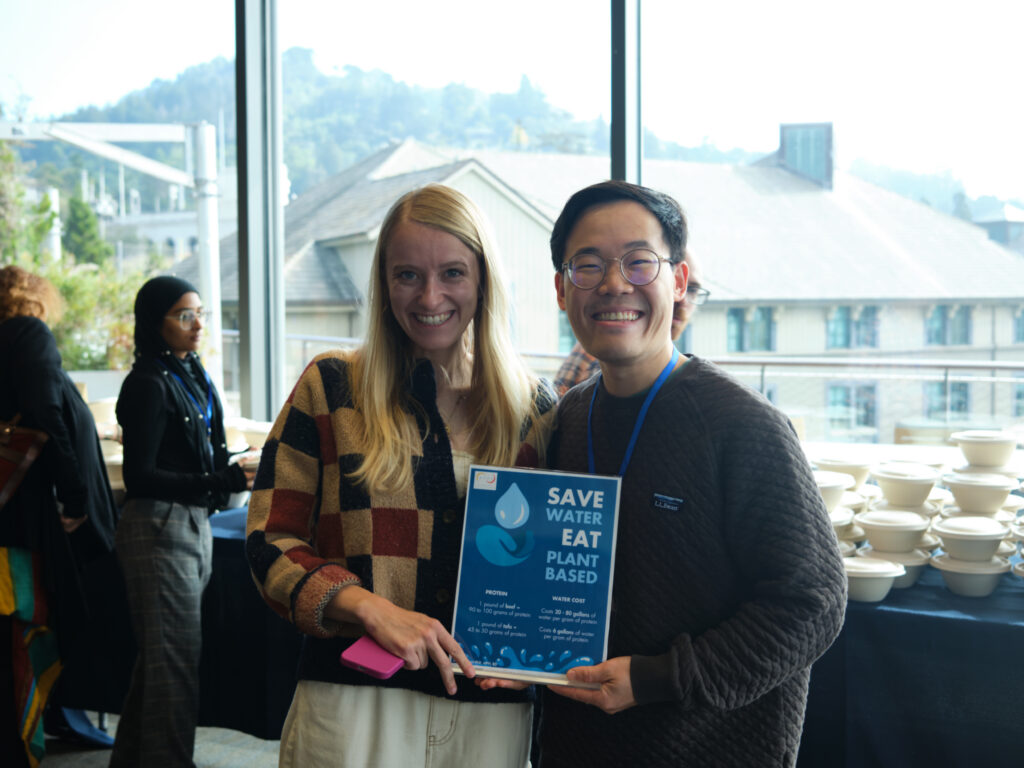
Sitara Sriram, Meg DeMarsh, and Steven Feng are full-time MBA students in the Haas Class of 2026, with backgrounds spanning tax consulting, fintech, brand marketing, and product management. They’re business thinkers who chose to apply their skills to help their school meet sustainability goals.
Their assignment, through the Plant Futures Challenge Lab, is to implement plant-based food defaults at the BERC Fall Symposium — the flagship sustainability conference hosted by UC Berkeley’s Energy and Resources Collaborative on October 30, 2025.
Each team member owned a distinct piece of the project. Sitara led caterer engagement and event invitations. Meg drove the menu redesign and the event planning guide. Steven documented the case study so the work could live beyond a single event. The split mattered: the project demanded vendor negotiation, behavioral design, and rigorous documentation simultaneously, and MBA training prepared them to hold all three at once.
The Partnership with Plant Futures Initiative
This collaboration didn’t happen by accident. It was made possible through a partnership with the Plant Futures Initiative — and two of its driving forces: Brittany Sartor and Miyoko Schinner.
The Better Food Foundation’s connection with UC Berkeley students was made possible through a partnership with the Plant Futures Initiative — Brittany, a UC Berkeley alumna, is the co-founder and Program Director of Plant Futures, the organization that runs the Plant Futures Challenge Lab. Through Plant Futures’ partnership with Better Food Foundation, Brittany first connected BFF with this student team, putting the collaboration into motion. Miyoko Schinner — pioneering vegan entrepreneur, founder of Miyoko’s Creamery, and a transformative figure in the plant-based dairy industry — co-instructs the course alongside Brittany.
Together, they built a program that bridges academia and real-world food systems change, and this partnership with Better Food Foundation reflects that vision. Plant Futures deliberately connects students with mission-aligned organizations like Better Food Foundation to develop meaningful climate solutions for college campuses — turning classroom thinking into tangible impact.
“Projects like the BERC symposium prove that plant-based defaults aren’t about restriction — they’re about creating delicious, sustainable options and making it effortless to choose climate-friendly food.”
— Kenzie Bushman, Education Manager, Better Food Foundation
The Plant Futures program connects students with organizations working to change that. We at Better Food Foundation, a nonprofit pioneering the use of behavioral science to make plant-based eating the easy, obvious, and delicious choice, are proud to be one of those partners.
Six Barriers to Plant-Based Campus Catering — and How to Solve Each One
One of the most valuable things this team did was refuse to sugarcoat the challenges. They named six key barriers to making plant-based catering the default on campus.
Barrier 1: Perception Gaps About Plant-Based Meals
Many people assume plant-based meals will not be satisfying. Research from the World Resources Institute consistently shows that how a dish is described and presented matters more than its protein source. A well-named, well-plated plant-based meal regularly meets or exceeds expectations.
Barrier 2: Cultural Norms Around Meat
Meat has long been the expected centerpiece of a meal in many settings. Defaults are powerful precisely because they quietly reshape norms. When plant-based is the starting point, it stops feeling like the exception and becomes the standard.
Barrier 3: Social Stigma at Group Meals
Choosing plant-based food can carry social judgment in some settings. Default framing removes that friction — you are not opting in to something different, you are simply eating what is served.
Barrier 4: Poor Menu Visibility
On most catering menus, plant-based options are buried at the bottom or labeled as alternatives, which makes them feel like afterthoughts. Flipping the menu so plant-based comes first changes what feels normal — a classic choice architecture technique.
Barrier 5: Protein and Satiety Anxiety
Concerns about satiety and nutrition persist, even when the evidence shows that well-planned plant-based meals easily meet protein needs. The fix is simple: always name the protein source on the menu.
Barrier 6: Respecting Food Tradition
Many cultural food traditions center on meat, and any effective strategy has to respect that. Plant-based defaults don’t erase tradition — they change the starting point while keeping all options on the table.
None of these are insurmountable, but ignoring them is a fast track to a failed initiative. The team’s approach was to work with them, not around them.
How to Implement: A Practical Guide for Plant-Based Defaults at Your Campus Event
Drawing on conversations with catering vendors, behavioral science experts, and campus stakeholders, the team built a practical, replicable playbook. These six tactics carried the BERC pilot and are key steps to any implementation.
1. Choose the Right Event to Pilot
Not every event is the right starting point. Student-run events offer significantly more flexibility than those led by administrators, and events already focused on climate or sustainability come with audiences primed to care about the choice. The BERC symposium checked both boxes — student-organized, sustainability-themed, with attendees who arrived pre-aligned with the values behind the menu. Look for events that match at least one of those criteria.
2. Engage Your Caterer Early
Understanding what vendors can and can’t do is essential before designing menus. Please don’t show up with a fixed menu and ask them to do it. Instead, ask what they do well, where they have plant-based experience, and which dishes have worked at past events. Build the menu around their strengths, and you’ll get better food, lower friction, and a vendor who becomes an ally for the next pilot.
3. Use Collective, Community-Focused Language
Framing matters. Asking individuals to make a sacrificial choice rarely works; framing the choice around community consistently does. Language like “join your fellow attendees in choosing the climate-friendly menu” outperforms individual asks. Research on social norms and food choice confirms that people eat more sustainably when they believe others around them are doing the same.
4. Make Menu Items Familiar, Not Fancy
Attendees gravitate toward dishes they recognize. A “Toasted Tofu Bowl” outperforms an abstract grain dish every time, and clearly naming the protein removes the most common source of menu hesitation. Save the culinary creativity for the flavor; keep the naming familiar and direct.
5. Don’t Rely on Signage Alone
Signs are useful for context, but the team found they don’t drive food selection on their own. What actually moves the needle is placement, prominence, and how the organizer verbally frames the options at the event. A two-sentence framing from the host at the start of lunch carries more weight than a printed sign on the buffet.
6. Don’t Forget Dessert
Cow’s milk has a significantly greater climate impact than plant-based alternatives across nearly every measurable category. Dessert is one of the easiest, most often-overlooked wins for a fully plant-forward menu — and it’s frequently the part of the meal attendees remember most. Don’t leave it on the table.
Results from the BERC Symposium Pilot

At the BERC Fall Symposium, plant-based meals were served as the default to all attendees, with animal-based options available on request. The food was well-received, the event ran smoothly, and the team came away with something more valuable than a successful lunch: a documented, replicable model that the next cohort of students can build on, refine, and share with other campuses.
The pilot also validated an important principle of behavioral design — when the structure of the choice is right, the choice itself becomes nearly invisible. Attendees ate well, discussed climate change, and went home. The menu didn’t need to advertise itself as a statement to function as one.
“We were thrilled to partner with the Better Food Foundation to introduce more plant-based options at Berkeley’s Energy and Resources Collaborative Symposium. We showcased both the great taste of the lunch offerings and the meaningful climate benefits of eating plant-based food.”
— Sitara Sriram, Meg DeMarsh, and Steven Feng
Why Plant-Based Default Programs Compound Over Time
Here’s what makes the Plant Futures and Better Food Foundation partnership so effective: it compounds. Every semester, a new cohort picks up where the last one left off — sharper guides, deeper catering relationships, more refined nudges. Over time, what starts as a single pilot becomes an institutional shift: a campus where plant-based food isn’t the alternative, it becomes the norm.
That is how systems actually change, not through mandates, but through smart design and persistent people equipped with the right tools.
Bring Plant-Based Defaults to Your Campus
You don’t need an MBA to do this. You don’t need a budget, a title, or anyone’s permission.
The DefaultVeg Internship Program, run by the Better Food Foundation, gives students everything they need to implement plant-based defaults and nudges on their own campuses: hands-on training in behavioral science, a step-by-step implementation toolkit, mentorship from people who have done this work before, and a community of students making it happen at campuses across the country.
What Sitara, Meg, and Steven proved at Berkeley is that one well-designed lunch can shift what an entire campus considers normal. The question isn’t whether this can work at your school. It’s who is going to make it happen.
If you’re a student or campus organizer ready to act, the tools and community are already waiting for you.
Apply to the DefaultVeg Internship Program for the Fall 2026 through Spring 2027 cohort. The application deadline is August 1, 2026
Frequently Asked Questions About Plant-Based Defaults for Campus Event Catering
What is a plant-based default?
A plant-based default is a structural choice that makes plant-based food the standard option served at an event, with animal-based options available on request. The default approach changes what people receive without requiring them to opt in, while still allowing anyone with dietary restrictions or who wants to choose the animal product option.
How do you implement plant-based catering at a college event?
Start with a sustainability-themed or student-run event, engage your caterer early to understand their plant-based strengths, design a menu around familiar dishes with clearly named proteins, frame the choice in collective rather than individual terms, and have the event organizer include it on the event registration or RSVP. The complete playbook is in the implementation section above.
Does plant-based catering cost more?
Generally no — and often less. Plant-based ingredients like grains, beans, and vegetables are typically cheaper per serving than animal products. Costs can rise if a menu leans heavily on premium meat substitutes. Still, a thoughtfully designed plant-based menu using whole-food ingredients is usually comparable to, or even cheaper than, a conventional catering order.
How do you handle attendees who want meat options?
They request them. The default approach never denies anyone food. Animal-based options remain available, but they require a small action to opt into rather than being served automatically. In practice, the vast majority of attendees stay with the default, which is exactly the behavioral effect that makes the strategy work.
What’s the difference between plant-based defaults and going fully vegan?
Plant-based defaults are a structural nudge: change what gets served first, keep all options on the table. Going vegan is an individual identity and lifestyle choice. Defaults work without asking anyone to adopt a label or change who they are — which is precisely why they scale at the institutional level in ways that individual advocacy often does not.
Where can students learn to run plant-based default programs?
The DefaultVeg Internship Program, run by the Better Food Foundation, trains students in behavioral science, provides an implementation toolkit, and connects them with a peer community running similar pilots—applications for the Fall 2026 through Spring 2027 cohort close August 1, 2026.
Latest News
See All News39 Campus Wins for Student-Led Plant-Based Nudges & Defaults
Sixty-five students, two semesters each, 39 changes to how campus food gets served. Here’s what the first year-long DefaultVeg 2025-26 cohort accomplished. And the next 90 interns start this Fall.
5 Takeaways on Plant-Based Campus Dining from NACUFS 2026
Five takeaways from our panel and the conference floor, on why the values-behavior gap is a design problem and what students actually order when you get it right.
Storytelling as Climate Strategy: Nudge Workshop with LARC & YP2F
Shredded Shiitake Mushroom Tacos. BBQ Jackfruit Wrap. Tropicali Flan made from kelp. Here’s what happened when BFF brought behavioral science to LA journalists at LARC x YP2F.