Taste, Performance, and Sustainability
Leading cafes like Blue Bottle, Birch Coffee, Stumptown, and Onyx Coffee Lab have made oat milk their default option, signifying that plant milk is quickly becoming the norm in cafes and coffee shops. The discussion around coffee has shifted from whether to offer plant milks to how to implement them effectively. As a result, many cafe owners now face an important decision: which plant milk options should they offer?
This guide aims to help cafe owners navigate the practical considerations of taste, frothing capability, costs, and environmental impact so you can make informed choices for your cafe.
The Market Reality: Why Plant Milk Is No Longer Optional
The demand for dairy alternatives isn’t just about preference—it’s about accessibility. According to the National Institutes of Health, approximately 65% of the global population has some degree of lactose intolerance, with rates varying significantly by ethnicity. This means that for the majority of your potential customers worldwide, dairy milk can cause digestive discomfort, bloating, and other unpleasant symptoms.
The statistics are striking when broken down by population:
- East Asian populations: 70-100% lactose intolerance
- African and African American populations: 60-80% lactose intolerance
- Hispanic/Latino populations: 50-80% lactose intolerance
- Southern European populations: 40-70% lactose intolerance
- Northern European populations: 5-25% lactose intolerance
For coffee shops, this means offering quality plant milk options isn’t just about following trends or environmental values—it’s about serving the majority of potential customers who cannot comfortably consume dairy. When you make plant milk easily accessible and delicious, you’re not catering to a niche market; you’re opening your doors to the global majority.
The Default Oat Milk Movement: Lessons from Industry Leaders
Several leading coffee shops have taken a bold stance by making oat milk their default option, leveraging behavioral nudges to influence diet shifts.
Blue Bottle Coffee made waves by switching to oat milk as its default across locations, citing customer preference and environmental considerations. Their baristas report that the switch was surprisingly smooth, with minimal pushback from customers who could still request dairy at no extra charge. Plus, this decision helped Blue Bottle reach its sustainability goals, achieving carbon neutrality.
Birch Coffee in New York similarly adopted oat milk as the default, noting that it reduced customer decision fatigue and streamlined their ordering process. They found that roughly 80% of customers who previously chose dairy were pleased with oat milk.
Stumptown Coffee Roasters and Onyx Coffee Lab have followed suit, both reporting that the change aligns with their sustainability values and actually improves drink quality for many of their espresso-based beverages.
The common thread? These cafes found that oat milk’s neutral-to-sweet flavor profile and superior steaming properties made it an accessible choice for the vast majority of their customers.
Breaking Down Your Options: A Practical Comparison
Oat Milk: The Barista’s Favorite
Taste: Naturally sweet with subtle oat and cereal notes. Enhances coffee without overpowering it, adding a gentle caramel-like quality to lighter roasts.
Froth Performance: Excellent. Creates silky microfoam ideal for latte art. Barista editions (like Oatly Barista or Minor Figures) are formulated to withstand heat.
Cost: Mid-range ($3-5 per liter wholesale). Barista editions cost 20-40% more than standard oat milk but deliver significantly better results.
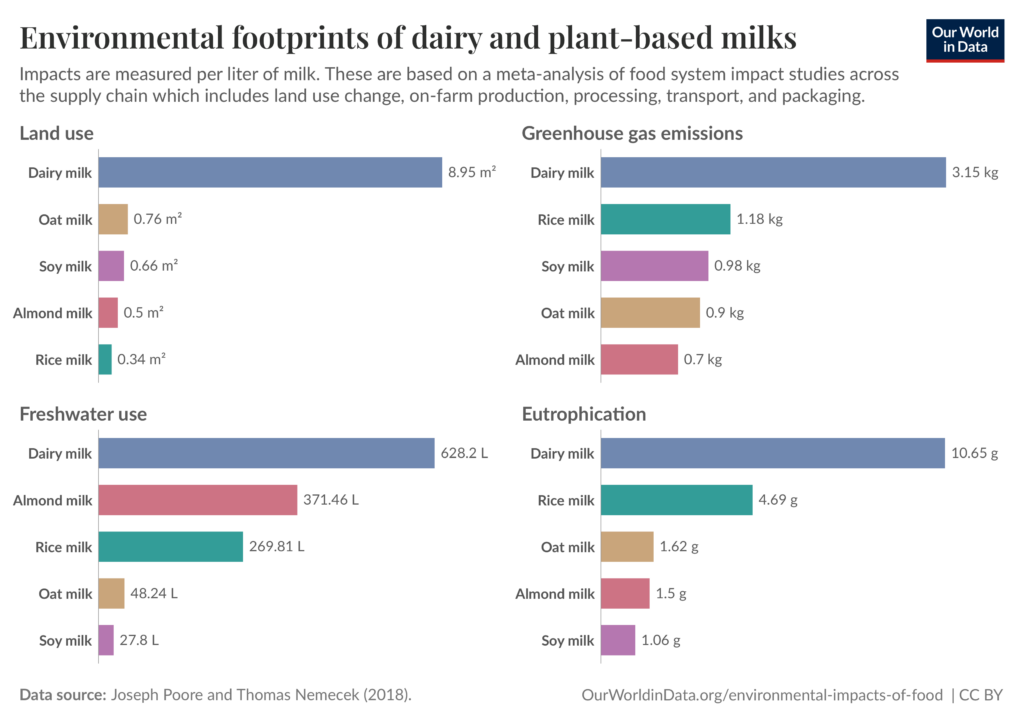
Environmental Impact: Strong performer. According to Our World in Data’s comprehensive analysis, oat milk produces 70% fewer greenhouse gas emissions than dairy milk (0.9 kg CO₂eq per liter vs. 3.2 kg for dairy). It requires dramatically less water than almond milk—just 48 liters of water per liter of oat milk compared to 371 liters for almond milk.
Verdict: The all-rounder. Best choice for cafes looking to simplify their menu while maintaining quality across all drinks.
Soy Milk: The Budget-Friendly Performer
Taste: Creamy with a subtle bean-like flavor that some customers notice. Works well with bold, dark roasts but can clash with delicate single-origins.
Froth Performance: Very good. A high protein content creates a stable foam similar to that of dairy milk. However, quality varies significantly by brand—look for options specifically labeled “barista blend.”
Cost: Budget-friendly ($2-4 per liter wholesale). Often, the most economical plant milk option.
Environmental Impact: Good. Our World in Data reports that soy milk produces approximately 1.0 kg CO₂eq per liter (similar to oat) and uses a moderate amount of water (28 liters per liter of milk).
Verdict: Reliable workhorse. Best for high-volume cafes looking to watch costs, especially for hot drinks where its creaminess shines.
Almond Milk: Light but Water-Intensive
Taste: Light and subtly nutty. It won’t overpower delicate coffee flavors, but it won’t add much body either.
Froth Performance: Challenging. Tends to separate at high heat and requires a careful steaming technique. Barista blends perform better but still lag behind oat and soy.
Cost: Mid-range ($3-4.50 per liter wholesale).
Environmental Impact: Mixed. While emissions are relatively low at 0.7 kg CO₂eq per liter (about 78% less than dairy), water usage is high—almonds require 371 liters of water per liter of milk, more than any other plant milk option.
Verdict: Best for iced drinks. Consider offering it for cold brew and iced lattes where frothing isn’t an issue.
Coconut Milk: The Tropical Specialty
Taste: Distinctive tropical flavor that divides opinion. Can complement specific coffee origins (think Indonesian or Central American beans) but may clash with others.
Froth Performance: Moderate. It can create decent foam but often lacks stability. The high fat content affects mouthfeel.
Cost: Mid-to-high range- $4- $ 5.50 per liter wholesale).
Environmental Impact: Good overall, with relatively low emissions (0.7 kg CO₂eq per liter) and moderate water usage (182 liters per liter of milk), according to environmental data from Our World in Data, though there are ethical concerns around labor practices in coconut farming.
Verdict: Specialty option. Best for flavored drinks or cafes with a tropical/beach aesthetic where the flavor is a feature.
Environmental Impact at a Glance: The Data You Need
When discussing sustainability with customers, having concrete numbers matters. Here’s how plant milks compare to dairy according to Our World in Data’s research:
Our Recommendations for Coffee Shops
For Most Coffee Shops: Start with Oat + Soy
If you’re carrying just two plant milk options, oat milk (barista edition) and soy milk give you the best coverage. Oat handles your premium espresso drinks and latte art, while soy provides a cost-effective option that still performs well in hot beverages. This combination satisfies about 95% of dairy-free customers.
The Three-Option Sweet Spot: Add Almond for Iced Drinks
Adding almond milk gives cold brew and iced latte enthusiasts a light, refreshing option. This trinity covers nearly all customer preferences without overwhelming your bar setup or inventory costs.
Environmental Leaders: Feature Oat Prominently
If sustainability is a core value for your cafe, oat milk as the default sends a clear message. With the lowest water usage among mainstream options and emissions comparable to those of soy and almonds, it’s the most defensible environmentally. Consider sharing data from Our World in Data on your menu or website to educate customers about the impact of their choices.
Best for Taste: Match Milk to Coffee Origin
Train your baristas to recommend specific milks for your rotating single-origins:
- Oat milk with light-to-medium roasts and fruity African coffees
- Soy milk with full-bodied South American and darker roasts
- Almond milk with nutty, chocolatey coffees
- Coconut milk with spiced or Indonesian coffees
Additional Delicious Options
Since the rise of plant milks, there are many new options available for coffee and tea drinks. Cashew milk, walnut milk, and pistachio milk are among the latest trend options. More familiar options include pea, hemp, and flax milk. (link)
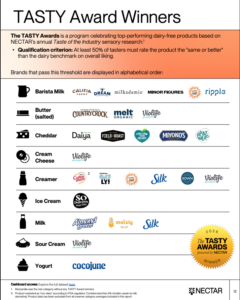
2026 Taste of the Industry: 98 Dairy-Free Products Across 10 Categories
Another great resource is Nectar’s Dairy-Alternative Products 2026 Report, the largest publicly available sensory study of dairy-free products on the market. This report provides objective sensory data on 98 dairy-free products collected through blind taste tests conducted in American restaurant settings.
The study evaluated 98 commercialized dairy-free products across 10 categories with 2,183 omnivore and flexitarian consumers in San Francisco and New York City. The winners are across milk, butter, cheese, cream cheese, sour cream, creamer, ice cream, and yogurt.
The top winners in the plant milk category include: Califia Farms, Dream, Milkadamia, Minor Figures, Planet Oat, and Ripple.
The Bottom Line: Making the Switch, It’s Easy
The success of Blue Bottle, Birch Coffee, Stumptown, and Onyx Coffee Lab demonstrates that customers are ready for plant milk default. Here’s how to implement changes smoothly:
- Start with quality: Invest in barista-edition oat milk. The performance difference justifies the cost.
- Train thoroughly: Give your team time to master steaming techniques for each milk. Plant milks require different practices than dairy.
- Communicate clearly: If implementing a plant milk default, make signage clear and friendly. “We proudly serve oat milk as standard—dairy available upon request” works better than corporate-speak.
- Price reasonably: Consider absorbing the upcharge for plant milks. Many successful cafes find that eliminating the surcharge increases customer loyalty and order frequency. It caters to 65% of lactose-intolerant customers.
- Track and adjust: Monitor which milks move and gather barista feedback. Your menu should evolve with customer preferences.
Frequently Asked Questions About Plant Milk for Coffee Shops
Q: Why is oat milk better for lattes than almond milk? A: Oat milk’s higher protein and fat content create more stable microfoam, essential for latte art and creamy texture.
Q: What’s the most sustainable plant milk? A: Based on environmental impact data, oat and soy milk are the most sustainable options, using significantly less water than almond milk while producing similar low emissions.
Q: How much does plant milk cost compared to dairy? A: Wholesale plant milks typically cost slightly more than dairy, but many cafes are absorbing this cost or making oat milk the default to align with customer values and cater to lactose intolerance. Also, plant milks are shelf-stable, averting dairy spoilage and waste. (Some cafes assign the surcharge to dairy or syrup add-ons.)
Q: Can you make latte art with plant milk? A: Yes! Barista-edition oat milk and quality soy milk can create excellent latte art. The key is using products specifically formulated for steaming and proper technique.
Related Resources
Latest News
See All NewsThe Coffee Shop Owners’ Guide to Choosing Plant Milks
Discover which plant milks work best for cafes. Compare oat, soy, almond & coconut milk for taste, froth, cost & environmental impact.
How DefaultVeg Interns Are Reshaping Global Food Systems
Discover how DefaultVeg Interns are revolutionizing campus dining by making plant-based options the delicious default.
A Student’s Case for an Oat Milk Default at Duke University
A guest blog by Marielle Williamson, a student at Duke Kunshan University, about the importance of adopting oat milk as the default in coffee shops.