What if the most meaningful climate action at your next event wasn’t a panel or a pledge — but the food on the buffet table?
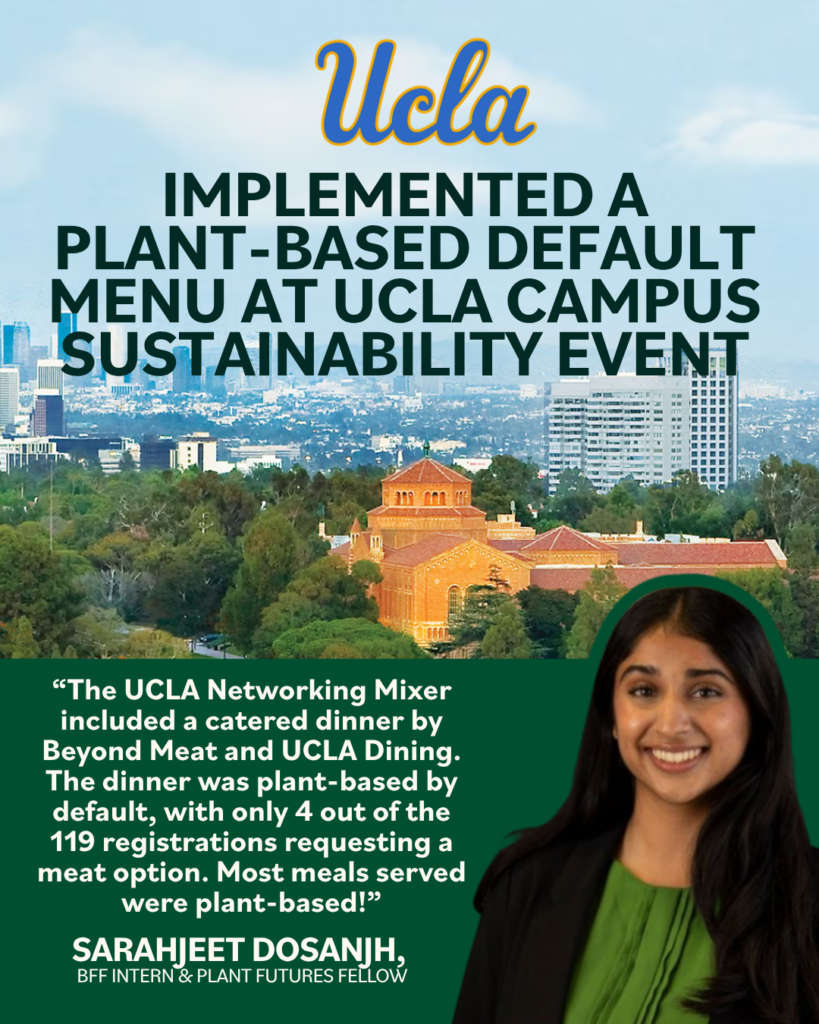
That’s the question Sarahjeet Dosanjh answered at the second annual Sustainable Food Futures: Career and Networking Fair at UCLA on November 13th, 2025. As the President of Plant Futures at UCLA, Sarahjeet helped redesign the menu so plant-based food became the standard, and meat the opt-in. The room was full of food systems professionals, sustainability advocates, and student leaders — and almost no one noticed they were eating a planet-friendly meal. They were just eating dinner.
The result: a single evening that prevented as much carbon pollution as taking dozens of cars off the road for a year.
From Backlash to Breakthrough
Sarahjeet’s path to this moment wasn’t a straight line — and that’s what makes her story so instructive.
At the 2024 Sustainable Food Futures event — a collaboration between Plant Futures at UCLA and the Rothman Family Institute for Food Studies — Sarahjeet and her student organization pushed hard for a fully plant-based menu at the networking mixer. The Rothman Institute’s leadership pushed back, insisting that meat stay on the menu—the result: a buffet heavy on animal products, and an inbox full of complaints. Attendees were frustrated that an event explicitly dedicated to sustainability and equitable food system reform was serving a menu that didn’t reflect those values.
That feedback lit a fire.
Finding the Path Forward: Plant-Based by Default
Determined to align the food with the mission, Sarahjeet approached the 2025 event with a new strategy. She spent the year building a genuine partnership with the Rothman Institute, and this time, she came to the table with a proposal rather than a demand.
“At first, I pushed for an all-plant-based menu, but my institutional partner had a policy preventing any of their events from being fully vegan. I consulted several local advocates to determine the best path forward, and they recommended that I propose plant-based by default to the institution team.
After compiling data on where it was implemented and some successes, I reached out to my organizing partner at the institute and submitted the proposal. They agreed enthusiastically, expressing great interest in the concept.” –Sarahjeet Dosanjh
This is the quiet power of plant-based defaults in action. Rather than eliminating choice, the default reframes it. Plant-based is the standard; those who want meat can still opt in. It’s a gentle nudge with an outsized impact — and the research backs it up. A large-scale study at the University of Cambridge found that doubling plant-based options on menus increased plant-based meal selection by up to 79%, and a study published in JAMA Network Open showed that when plant-based meals are the default at events, most people stick with that choice — even when opting out is easy.
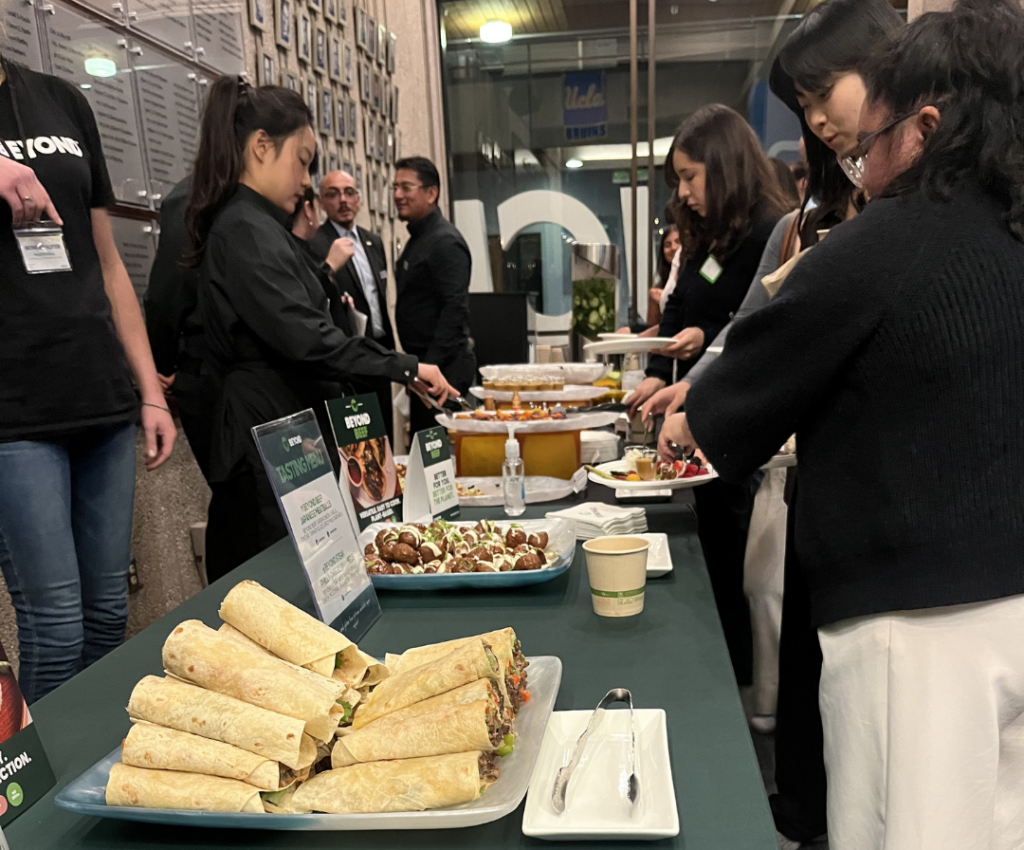
Sarahjeet and her student organizations secured a partnership with Beyond Meat and worked with UCLA Dining to bring the vision to life. Her team made sure the offerings were satisfying, tasty, and full of plant-rich flavor. Event registration included clear language: the meal would be plant-based by default, with the option to request meat.
Of 119 registrants, only 4 requested a meat option.
One small plate of meat (without dairy) was served at the event. Everything else on the table was plant-based.
Why Catered Events Are a Bigger Climate Lever Than You Think
When we think about food-related emissions, we usually focus on everyday habits — what’s in the fridge, what’s on the dining hall menu, what we order at restaurants. But catered events are a surprisingly significant and often overlooked opportunity.
The average catered meal generates considerably more emissions than a home-cooked one, driven by large quantities of animal protein, food waste, and single-use packaging. And unlike a dining hall that runs every day of the year, events are discrete, time-limited, and organizationally flexible — making them ideal testing grounds for plant-based defaults.
The stakes are real. Food systems account for roughly one-third of all global greenhouse gas emissions (Nature Food, 2021), with animal agriculture as the single largest contributor. Beef alone generates up to 20 times more emissions per gram of protein than plant-based alternatives like legumes. Dairy, while less carbon-intensive than beef, still carries a significant environmental footprint, particularly in water and land use. (FAO)
The good news? Shifting toward plant-rich diets is one of the highest-impact climate solutions available to individuals and institutions. And when that shift happens through a default, it doesn’t depend on individuals making a conscious, effortful choice every single time. The sustainable option becomes the normal one.
This is exactly why the Better Food Foundation focuses on defaults rather than individual behavior change campaigns. When the system changes, the outcomes change — without placing the full burden of climate action on the individual diner.
Events like the Sustainable Food Futures Fair, attended by professionals already engaged in food systems work, carry an extra layer of significance. What’s served at these gatherings signals what the food systems community itself values and normalizes. A sustainability conference with a meat-heavy buffet is, at minimum, a missed opportunity. A sustainability conference with a plant-based default menu is a statement.
The Results: Real, Measurable, Replicable
Attendee satisfaction at the 2025 event was dramatically higher than the year before — a testament to how much participants valued food that matched the event’s ethos.
But the environmental impact is where the numbers really stand out.
By implementing a plant-based default for a single evening, the event saved between 137.2 and 215.7 kg of CO₂ — the equivalent of taking 29 to 46 cars off the road for an entire year. And that doesn’t account for the additional savings in water use, land use, animal lives saved, and public health from one dinner.
This is the multiplying of defaults: when plant-based becomes the easy, expected choice, individual decisions add up to collective transformation.
What Sarahjeet Learned
Sarahjeet walked away with lessons any campus food systems advocate can use:
On flexibility
“This project helped me learn the importance and nature of flexibility when organizing events or projects. It is important to remain open-minded to changes from your original plan, as it allows collaborators and stakeholders to input their opinions throughout the process, yielding a stronger outcome.”
On strategy
“I learned that plant-based by default is incredibly palatable to individuals who might be allies in some aspects of food system reform, but not necessarily 100% aligned with plant-based. It taught me that even if your ideal choice doesn’t pan out, there are still other options to keep your goals in line.”
On persistence
“I would advise other students to keep pushing for an outcome that they can walk away feeling proud of. Although it might take time and extensive communication with stakeholders, there is always a pathway to get your foot in the door and implement some level of plant-based by default.”
And one welcome surprise: the Rothman Family Institute, a prominent voice in food systems, had never heard of plant-based by default before Sarahjeet introduced the concept. *”I was glad to introduce the concept to the team, and hopefully inspire them to implement something similar in the future,”* she shares.
That’s the ripple effect of this work. Every institution that encounters plant-based defaults for the first time becomes a potential future champion.
Your Event Could Be Next
Sarahjeet’s story is proof that plant-based defaults don’t require a perfect institutional environment. They require creativity, persistence, and a willingness to meet partners where they are.
The Better Food Foundation’s DefaultVeg Internship equips students like Sarahjeet with the behavioral science tools, advocacy strategies, and community support to make exactly this kind of change happen — on campuses, at events, and beyond.
Inspired to bring plant-based defaults to your school or organization?
👉 Apply for the DefaultVeg Internship or contact us to learn more.
And if you’ve implemented a plant-based default of your own, we want to hear about it — email us!
Latest News
See All NewsStorytelling as Climate Strategy: Nudge Workshop with LARC & YP2F
Shredded Shiitake Mushroom Tacos. BBQ Jackfruit Wrap. Tropicali Flan made from kelp. Here’s what happened when BFF brought behavioral science to LA journalists at LARC x YP2F.
Comedy as a Climate Solution: On the Stand
Inside On the Stand, a comedian-lawyer mock trial putting Big Meat & Dairy on trial at the Hollywood Climate Summit. And why comedy is a powerful storytelling tool for food systems change.
How Three UC Berkeley MBAs Made Plant-Based the Default
Here’s how they did it, what they learned, and how you can bring plant-based defaults and the PlantFutures program to your campus.