Guest blog by Marielle Williamson, student at Duke Kunshan University. Original blog posted on The LilyPad for the Plant Future’s Club and Never Mind Cafe at DKU in China. Photos by Marielle Williamson.
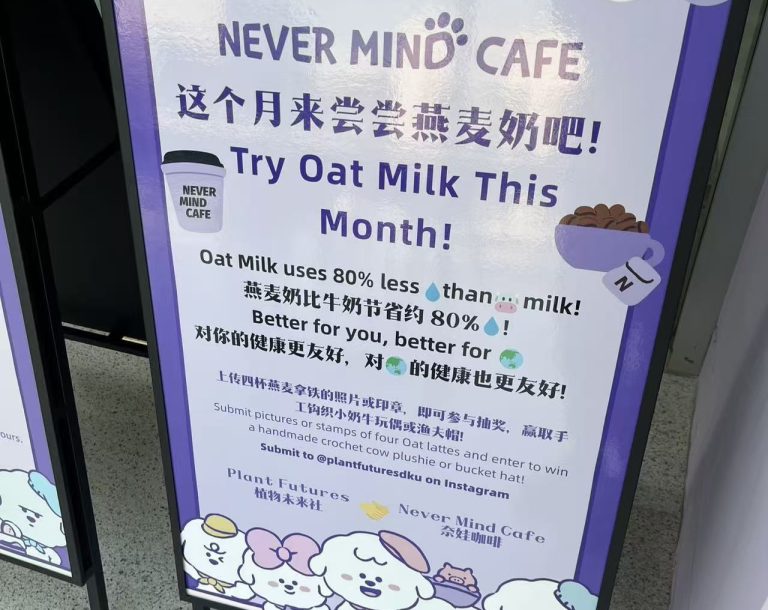
Photo: Marielle Williamson
Picture this: it’s a cold, early morning in Kunshan, you’re rushing to class, and in your hands lies a cup of warmth.
It’s not an uncommon situation–college campuses basically run on coffee. But where does it come from? Why should we care? And–perhaps most importantly–what can we do about it?
The Plan Futures club has organized a collaboration with the Never Mind Cafe to use oat as the default milk type throughout November. Plant Futures has also been experimenting with different forms of incentives, including silly social media promotion videos, advertisements around the school, and raffling off the chance to win a handmade crocheted cow or hat with the purchase of four oat milk lattes. We are also using this opportunity to build on our guanxi, or relationship with DKU’s canteen and café staff, most of whom speak only Chinese and sign language–a broader message of how coffee is just one way DKU’s initiative to bridge culture, language, and cross-cultural understanding manifests itself. Our long-term aim is to implement a permanent default (meaning dairy is still available, but only upon specification), as integrating institutional plant-based shifts is a necessary part of tackling the climate crisis.
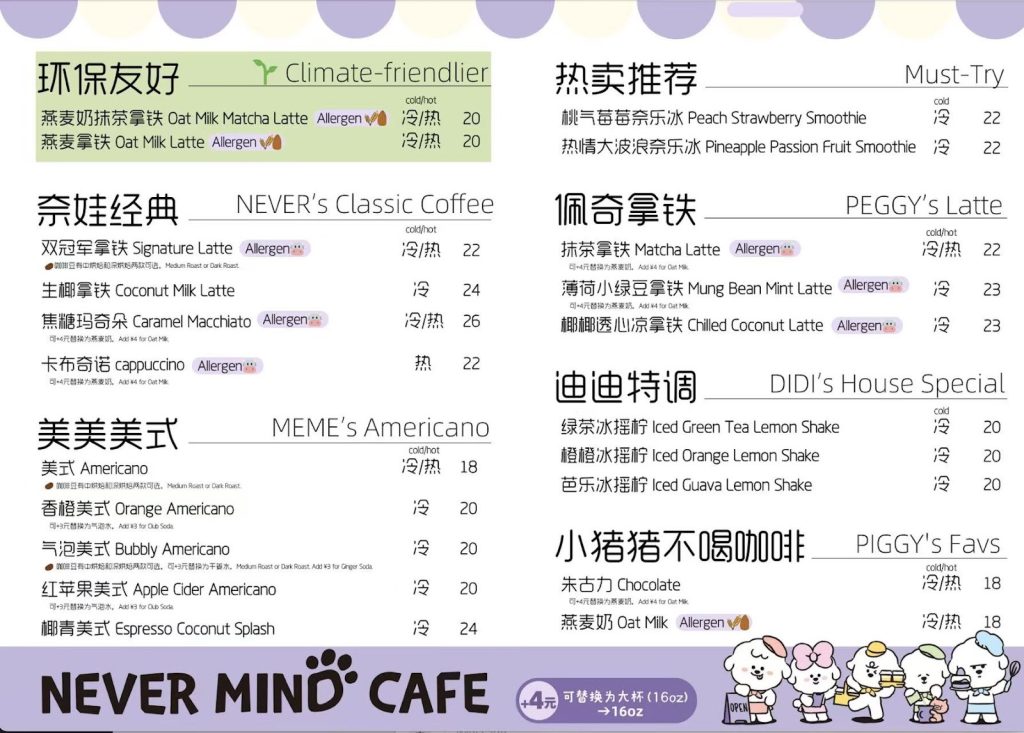
According to Our World in Data, one cup of cow’s milk requires about 120 liters of water. If we multiply that by however many lattes one drinks a week, that’s a lot of water. Now imagine you could have that same latte for one-tenth of the water, if not less.
On the water and land used to grow plants (77% of which goes to livestock), then to their transport and reduction to animal feed, and finally to the dairy, eggs, or meat that come out of it, for less than ¼ of our calories. These industries, particularly beef and dairy, are the primary drivers behind deforestation in the Amazon. Even independent of crop or animal transport, just one liter of cow’s milk comes at an immense 3.2 kilograms of carbon dioxide, compared to the 0.9 kilograms from oat milk. Our allocation of the world’s emissions, water, and land makes it so that 100 billion large land animals have full bellies every night, while 800 million humans continue to starve. This is the industry behind the frothy white foam in our lattes–and this is why we need to care.
It is categorically impossible to meet the Paris Accord’s climate targets without addressing our food system. With nearly all zoonotic diseases originating from animal rearing, about 70–80% of the world’s antibiotics are fed to animals, not to mention the 14.5% of total greenhouse gas emissions from factory farming–more than transportation and shipping combined–a shift away from overreliance on meat and animal products is imperative, and fast. Switching to oat milk cuts emissions by about two-thirds. It’s one of the simplest and cleanest climate actions available at the individual level. Multiplied over months, the numbers cannot be understated.
Our choices matter, but circumstance does too. When plant-based alternatives are provided as a default, with no changes in price, convenience, or accessibility, one latte makes a shocking difference. Other schools, such as Cornell University, have started implementing these shifts, as well as some with even broader commitments to 50% plant-based dining (UMichigan, UCLA, and UC Berkeley by 2027).
When asked why we, Plant Futures DKU, are piloting an oat milk default at Never Mind Café this month, these environmental statistics are our initial response. Our second reason is health consciousness. Decades of research show that higher intakes of full-fat dairy are linked to increased risks of cardiovascular disease, type 2 diabetes, and several cancers.
Increased accessibility is also a factor, given the prevalence of lactose intolerance, with much higher rates among people of color, including about 90% in East Asians, 60% in Hispanics, 95% in Indigenous populations, and 70–80% in African and African-diaspora communities. Human health at the hands of these industries extends to those affected by waste, pollution, and runoff around these industries, most of whom face higher rates of asthma and lung-related disease. It’s also important to mention that slaughterhouse and processing plant workers experience some of the highest PTSD rates of any civilian job, alongside documented injuries, trauma, and exploitation, including cases of underage labor.
Plant Futures also holds a lesser-known ethical component as a core driver for change: Behind every carton of dairy is a cow repeatedly impregnated, separated from her calves, and kept in a cycle of production until her body can no longer sustain it–because, like all mammals, cows must be pregnant to produce milk. The emotional distress, the confinement, and the premature endings are all built into the system. Oat milk removes systemic animal suffering from a coffee cup. Combined with the human rights, health, and climate benefits, choosing oat milk this month is one small way to align these values with our habits, without sacrificing taste, price, or convenience.
We often imagine solutions to big world problems as a new, crazy technology, a billion-dollar initiative, or a celebrity-backed crowd campaign. Billie Eilish just donated $11.5 million specifically towards driving plant-based food shifts.
A university choosing to implement oat milk as the default option, without removing the option for dairy for those who prefer it, is one of the simplest and most effective interventions to implement in everyday life. Change can feel overwhelming, but it starts slowly, with little nudges, such as choosing oat milk, that add up to a significant impact. As norms shift, so does our perception of them.
So change the way you perceive cow’s milk, your coffee, the little daily habits that matter–because they do, even if it’s just one sip at a time.
Latest News
See All News39 Campus Wins for Student-Led Plant-Based Nudges & Defaults
Sixty-five students, two semesters each, 39 changes to how campus food gets served. Here’s what the first year-long DefaultVeg 2025-26 cohort accomplished. And the next 90 interns start this Fall.
5 Takeaways on Plant-Based Campus Dining from NACUFS 2026
Five takeaways from our panel and the conference floor, on why the values-behavior gap is a design problem and what students actually order when you get it right.
Storytelling as Climate Strategy: Nudge Workshop with LARC & YP2F
Shredded Shiitake Mushroom Tacos. BBQ Jackfruit Wrap. Tropicali Flan made from kelp. Here’s what happened when BFF brought behavioral science to LA journalists at LARC x YP2F.